A) 0
B) .8
C) .33
D) Cannot be determined.
F) A) and D)
Correct Answer

verified
Correct Answer
verified
A) exposure analysis, discount analysis, distributions analysis.
B) episodic analysis, dose-exposure analysis, community characterization.
C) exposure analysis, dose-response analysis, risk characterization.
D) emission analysis, dose-response analysis, community characterization.
F) A) and D)
Correct Answer
verified
Correct Answer
verified
A) prepare a clear overview of the project including specifics about scale and perspective
B) estimate the social costs and benefits of the inputs and outputs of the project
C) quantitatively describe the inputs and the outputs of the program
D) all of the above are steps in benefit-cost analysis
F) A) and D)
Correct Answer
verified
Correct Answer
verified
A) time preference.
B) whether the effects cross generations.
C) the rate of inflation.
D) all of the above.
F) B) and C)
Correct Answer
verified
Correct Answer
verified
A) people in the same circumstances identically.
B) people in the same circumstances proportionately.
C) people in different circumstances differently.
D) none of the above.
F) A) and D)
Correct Answer
verified
Correct Answer
verified
A) Project A
B) Project B
C) Project C
D) The projects are equal in the present value of their net benefits.
F) A) and C)
Correct Answer
verified
Correct Answer
verified
A) determination of the baseline resource quality.
B) the choice of alternative ways of restoring a resource in a cost-effective way.
C) the determination of a natural or environmental resource of equivalent value.
D) all of the above are difficulties with determining restoration costs.
F) A) and B)
Correct Answer
verified
Correct Answer
verified
A) Environmental Protection Agency (EPA) .
B) Environmental Impact Agency (EIA) .
C) Regulatory Impact Agency (RIA) .
D) National Environmental Policy Act (NEPA) .
F) B) and C)
Correct Answer
verified
D
Correct Answer
verified
A) proportional; less
B) proportional; the same
C) proportional; greater
D) progressive; the same
F) None of the above
Correct Answer
verified
Correct Answer
verified
A) benefit-cost analysis
B) cost effectiveness analysis
C) regulatory impact analysis
D) resource damage assessment
F) All of the above
Correct Answer
verified
Correct Answer
verified
A) progressive; less
B) regressive; greater
C) progressive; higher
D) progressive; the same
F) B) and C)
Correct Answer
verified
Correct Answer
verified
A) project long-term costs
B) project net benefits
C) project long-run benefits
D) project discount rate
F) A) and C)
Correct Answer
verified
B
Correct Answer
verified
A) +$83,698.
B) -$84,242.
C) - $96,272.
D) None of the above.
F) A) and B)
Correct Answer
verified
Correct Answer
verified
A) consumer preferences as revealed in market prices are maximized where MAC=MD.
B) damages are minimized where MAC=MD.
C) total abatement costs are less that total damage costs where MAC=MD.
D) net social benefits are maximized where MAC = MD.
F) A) and D)
Correct Answer
verified
Correct Answer
verified
A) benefit estimation
B) damage calculation
C) discounting future benefits
D) exposure analysis
F) A) and C)
Correct Answer
verified
Correct Answer
verified
A) proportional; less
B) regressive; greater
C) regressive; the same
D) regressive; lower
F) A) and B)
Correct Answer
verified
Correct Answer
verified
A) reduction in phosphorus inputs from agricultural runoff
B) alum treatment of sediments in the bay
C) tertiary treatment at sewage treatment plants
D) treatment of wastewater from water treatment plants 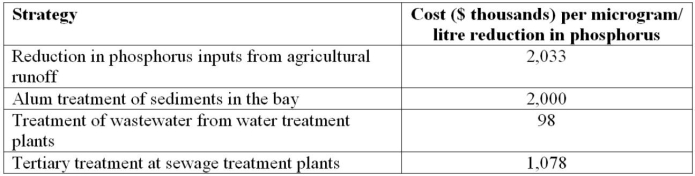
F) A) and D)
Correct Answer
verified
Correct Answer
verified
A) estimates the costs of competing alternative approaches to achieving that objective.
B) compares the benefits of that objective and the costs of obtaining that objective.
C) estimates the damage or effect of obtaining that objective on a valued resource.
D) compares it to the effects of other competing objectives.
F) A) and B)
Correct Answer
verified
A
Correct Answer
verified
A) 0
B) .8
C) .33
D) Cannot be determined.
F) None of the above
Correct Answer
verified
Correct Answer
verified
A) estimates the benefits and costs of a project in monetary terms
B) estimates the benefits but not the costs of projects
C) estimates the costs but not the benefits of projects
D) analyzes neither the benefits nor costs of projects
F) All of the above
Correct Answer
verified
Correct Answer
verified
Showing 1 - 20 of 30
Related Exams