Filters
Question type

Study Flashcards

A certain first-order reaction A → B is 25% complete in 42 min at 25°C. What is the half-life of the reaction?


A) 21 min
B) 42 min
C) 84 min
D) 120 min
E) 101 min

F) C) and D)
G) A) and B)

Correct Answer

verifed

verified

The following initial rate data apply to the reaction F2(g) + 2Cl2O(g) → 2FClO2(g) + Cl2(g) . The following initial rate data apply to the reaction F<sub>2</sub>(g)  + 2Cl<sub>2</sub>O(g)  → 2FClO<sub>2</sub>(g)  + Cl<sub>2</sub>(g) .   Which of the following is the rate law for this reaction? A)  rate = k[F<sub>2</sub>]<sup>2</sup>[Cl<sub>2</sub>O]<sup>4</sup> B)  rate = k[F<sub>2</sub>]<sup>2</sup>[Cl<sub>2</sub>O] C)  rate = k[F<sub>2</sub>][Cl<sub>2</sub>O] D)  rate = k[F<sub>2</sub>][Cl<sub>2</sub>O]<sup>2</sup> E)  rate = k[F<sub>2</sub>]<sup>2</sup>[Cl<sub>2</sub>O]<sup>2</sup> Which of the following is the rate law for this reaction?


A) rate = k[F2]2[Cl2O]4
B) rate = k[F2]2[Cl2O]
C) rate = k[F2][Cl2O]
D) rate = k[F2][Cl2O]2
E) rate = k[F2]2[Cl2O]2

F) C) and E)
G) B) and D)

Correct Answer

verifed

verified

For the reaction A + 2B → C, which expression is correct?


A) Δ[C]/Δt = Δ[A]/Δt
B) Δ[C]/Δt = 2Δ[B]/Δt
C) Δ[C]/Δt = -2Δ[B]/Δt
D) Δ[C]/Δt = -½Δ[B]/Δt
E) Δ[C]/Δt = -½Δ[A]/Δt

F) C) and D)
G) None of the above

Correct Answer

verifed

verified

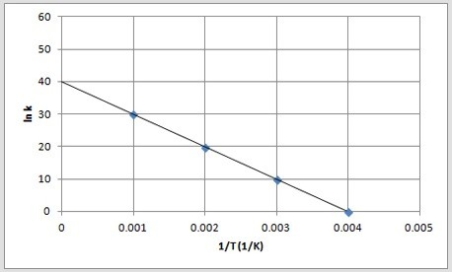
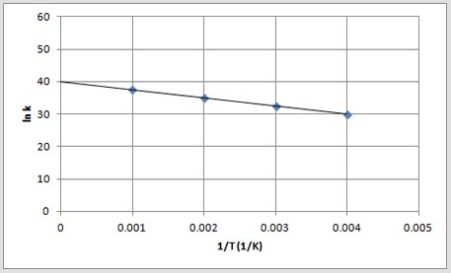
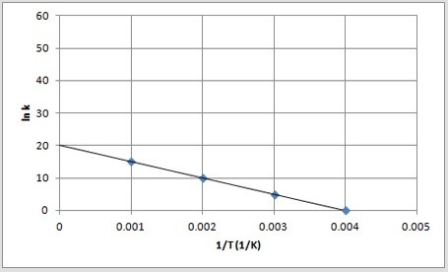
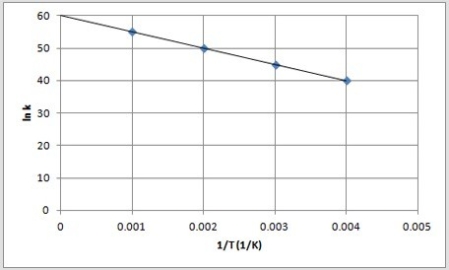
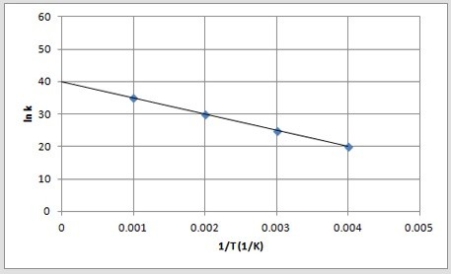
The following is an Arrhenius plot of a first-order reaction. The rate constant is measured in units of s-1. The following is an Arrhenius plot of a first-order reaction. The rate constant is measured in units of s<sup>-1</sup>.   If a catalyst is added to the reaction, which could correspond to an Arrhenius plot of the catalyzed reaction? A)    B)    C)    D)    E)   If a catalyst is added to the reaction, which could correspond to an Arrhenius plot of the catalyzed reaction?


A) The following is an Arrhenius plot of a first-order reaction. The rate constant is measured in units of s<sup>-1</sup>.   If a catalyst is added to the reaction, which could correspond to an Arrhenius plot of the catalyzed reaction? A)    B)    C)    D)    E)
B) The following is an Arrhenius plot of a first-order reaction. The rate constant is measured in units of s<sup>-1</sup>.   If a catalyst is added to the reaction, which could correspond to an Arrhenius plot of the catalyzed reaction? A)    B)    C)    D)    E)
C) The following is an Arrhenius plot of a first-order reaction. The rate constant is measured in units of s<sup>-1</sup>.   If a catalyst is added to the reaction, which could correspond to an Arrhenius plot of the catalyzed reaction? A)    B)    C)    D)    E)
D) The following is an Arrhenius plot of a first-order reaction. The rate constant is measured in units of s<sup>-1</sup>.   If a catalyst is added to the reaction, which could correspond to an Arrhenius plot of the catalyzed reaction? A)    B)    C)    D)    E)
E) The following is an Arrhenius plot of a first-order reaction. The rate constant is measured in units of s<sup>-1</sup>.   If a catalyst is added to the reaction, which could correspond to an Arrhenius plot of the catalyzed reaction? A)    B)    C)    D)    E)

F) A) and C)
G) A) and B)

Correct Answer

verifed

verified

Which is the correct unit for a first-order rate constant?


A) s-1
B) M • s-1
C) M • s
D) M -1 • s-1
E) M -2 • s-1

F) C) and D)
G) B) and C)

Correct Answer

verifed

verified

The reaction A + 2B → Products has been found to have the rate law, rate = k[A][B]2. While holding the concentration of A constant, the concentration of B is increased to three times its initial value. By what factor does the rate of reaction increase?


A) 3
B) 6
C) 9
D) 27
E) 30

F) None of the above
G) A) and B)

Correct Answer

verifed

verified

Below is a plot of the reaction of A decomposing to form products. Below is a plot of the reaction of A decomposing to form products.   Based on the figure, which might be the order of the reaction with respect to A? A)  The reaction must only be zeroth order in A. B)  The reaction must only be first order in A. C)  The reaction must only be second order in A. D)  The reaction could be either first order in A or second order in A. E)  The reaction could be of any order in A. Based on the figure, which might be the order of the reaction with respect to A?


A) The reaction must only be zeroth order in A.
B) The reaction must only be first order in A.
C) The reaction must only be second order in A.
D) The reaction could be either first order in A or second order in A.
E) The reaction could be of any order in A.

F) C) and E)
G) A) and B)

Correct Answer

verifed

verified

The step of the reaction mechanism which is the slowest step is called ________-________.

Correct Answer

verifed

verified

The rate law predicted by the following two-step mechanism is Rate = k[A][B]. A → C + B (slow) A + B → C + E (fast)

A) True
B) False

Correct Answer

verifed

verified

For the reaction A(g) + 2B(g) → 2C(g) + 2D(g) The following data were collected at constant temperature. Determine the correct rate law for this reaction. For the reaction A(g)  + 2B(g)  → 2C(g)  + 2D(g)  The following data were collected at constant temperature. Determine the correct rate law for this reaction.   A)  Rate = k[A][B] B)  Rate = k[A]<sup>2</sup>[B] C)  Rate = k[A][B]<sup>2</sup> D)  Rate = k[A] E)  Rate = k[A]<sup>3</sup>


A) Rate = k[A][B]
B) Rate = k[A]2[B]
C) Rate = k[A][B]2
D) Rate = k[A]
E) Rate = k[A]3

F) A) and B)
G) All of the above

Correct Answer

verifed

verified

What is the name given to the slowest step in the mechanism of a reaction?


A) Catalytic step
B) Mechanistic step
C) Rate-determining step
D) Step 1
E) Rate step

F) C) and D)
G) A) and C)

Correct Answer

verifed

verified

Consider the general reaction 5Br-(aq) + BrO3-(aq) + 6H+(aq) → 3Br2(aq) + 3H2O(aq) For this reaction, which is equal to Δ[Br2]/Δt?


A) -Δ[H2O]/Δt
B) 3Δ[BrO3-]/Δt
C) -5Δ[Br-]/Δt
D) -0.6Δ[Br-]/Δt
E) None of these choices is correct.

F) A) and B)
G) A) and C)

Correct Answer

verifed

verified

Showing 121 - 132 of 132

Related Exams

Show Answer