Filters
Question type

Study Flashcards

_______ ________ states that the volume of a fixed amount of gas maintained at constant pressure is directly proportional to the absolute temperature of a gas.

Correct Answer

verifed

verified

A(n) ________ is an instrument used to measure the atmospheric pressure.

Correct Answer

verifed

verified

A 7.75-L flask contains 0.482 g of hydrogen gas and 4.98 g of oxygen gas at 65°C. What is the partial pressure of oxygen in the flask?


A) 0.557 atm
B) 0.043 atm
C) 1.11 atm
D) 33.5 atm
E) 67 atm

F) B) and D)
G) A) and C)

Correct Answer

verifed

verified

A flask containing neon gas is connected to an open-ended mercury manometer. The open end is exposed to the atmosphere, where the prevailing pressure is 745 torr. The mercury level in the open arm is 5.0 cm below that in the arm connected to the flask of neon. What is the neon pressure, in torr?


A) -50. torr
B) 50. torr
C) 695 torr
D) 745 torr
E) 795 torr

F) B) and E)
G) B) and D)

Correct Answer

verifed

verified

What mass of KClO3 must be decomposed to produce 126 L of oxygen gas at 133°C and 0.880 atm? (The other reaction product is solid KCl.) (R = 0.08206 L • atm/K • mol)


A) 24.6 g
B) 70.8 g
C) 272 g
D) 408 g
E) 612 g

F) A) and D)
G) A) and C)

Correct Answer

verifed

verified

What is the density of SF6(g) at 27°C and 0.500 atm pressure? (R = 0.08206 L • atm/K • mol)


A) 3.38 × 10⁻³ g/L
B) 2.97 g/L
C) 22.4 g/L
D) 32.9 g/L
E) 3.38 kg/L

F) B) and E)
G) All of the above

Correct Answer

verifed

verified

A 2.50-L flask contains a mixture of methane (CH4) and propane (C3H8) at a pressure of 1.45 atm and 20°C. When this gas mixture is then burned in excess oxygen, 8.60 g of carbon dioxide is formed. (The other product is water.) What is the mole fraction of methane in the original gas mixture?


A) 0.34
B) 1.00
C) 0.66
D) 0.85
E) 0.15

F) All of the above
G) B) and C)

Correct Answer

verifed

verified

A sample of carbon dioxide gas at 125°C and 248 torr occupies a volume of 275 L. What will the gas pressure be if the volume is increased to 321 L at 125°C?


A) 212 torr
B) 289 torr
C) 356 torr
D) 441 torr
E) 359 torr

F) A) and B)
G) B) and E)

Correct Answer

verifed

verified

A spacecraft is filled with 0.500 atm of N2 and 0.500 atm of O2. Suppose an object strikes this spacecraft and puts a very small hole in its side. Under these circumstances,


A) O2 is lost from the craft 6.9% faster than N2 is lost.
B) O2 is lost from the craft 14% faster than N2 is lost.
C) N2 is lost from the craft 6.9% faster than O2 is lost.
D) N2 is lost from the craft 14% faster than O2 is lost.
E) N2 and O2 are lost from the craft at the same rate.

F) A) and B)
G) B) and E)

Correct Answer

verifed

verified

What are the conditions of STP?


A) 0 K and 1 atm
B) 273.15 K and 760 torr
C) 0°C and 760 atm
D) 273.15°C and 760 torr
E) 0°C and 1 torr

F) B) and E)
G) A) and B)

Correct Answer

verifed

verified

A sample of gas occupies 24.5 L at a pressure of 1.57 atm. What is the pressure if the volume is increased to 48.3 L at constant temperature?


A) 0.796 atm
B) 1.26 atm
C) 3.10 atm
D) 5.38 × 10⁻⁴ atm
E) 1.86 × 10³ atm

F) B) and E)
G) B) and C)

Correct Answer

verifed

verified

How many grams of carbon dioxide are contained in 550 mL of this gas at STP?


A) 0.0245 g
B) 0.0280 g
C) 1080 g
D) 0.560 g
E) 1.1 g

F) A) and B)
G) D) and E)

Correct Answer

verifed

verified

________ is the formula to determine the molar mass of a compound using the ideal gas law.

Correct Answer

verifed

verified

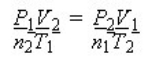
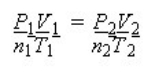
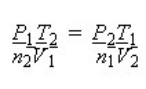
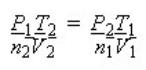
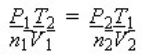
What is the formula which describes the relationship between the pressure, volume, temperature, and moles?


A) What is the formula which describes the relationship between the pressure, volume, temperature, and moles? A)    B)    C)    D)    E)
B) What is the formula which describes the relationship between the pressure, volume, temperature, and moles? A)    B)    C)    D)    E)
C) What is the formula which describes the relationship between the pressure, volume, temperature, and moles? A)    B)    C)    D)    E)
D) What is the formula which describes the relationship between the pressure, volume, temperature, and moles? A)    B)    C)    D)    E)
E) What is the formula which describes the relationship between the pressure, volume, temperature, and moles? A)    B)    C)    D)    E)

F) A) and E)
G) C) and E)

Correct Answer

verifed

verified

The catalytic decomposition of hydrogen peroxide yields oxygen gas and water. In an experiment, decomposition of hydrogen peroxide yielded 75.3 mL of gas collected over water at 25°C and 742 torr. What mass of oxygen gas was collected? (Pwater = 24 torr at 25°C, R = 0.08206 L • atm/K • mol)


A) 0.00291 g
B) 0.0931 g
C) 0.0962 g
D) 0.0993 g
E) 0.962 g

F) All of the above
G) A) and B)

Correct Answer

verifed

verified

Gases form heterogeneous mixtures or solutions with one another.

A) True
B) False

Correct Answer

verifed

verified

A sample of nitrogen gas is confined to a 14.0-L container at 375 torr and 37.0°C. How many moles of nitrogen are in the container? (R = 0.08206 L • atm/K • mol, 1 atm = 760 torr)


A) 0.272 mol
B) 2.27 mol
C) 3.69 mol
D) 206 mol
E) 227 mol

F) B) and D)
G) B) and E)

Correct Answer

verifed

verified

A flask with a volume of 3.16 L contains 9.33 g of an unknown gas at 32.0°C and 1.00 atm. What is the molar mass of the gas? (R = 0.08206 L • atm/K • mol)


A) 7.76 g/mol
B) 66.1 g/mol
C) 73.9 g/mol
D) 81.4 g/mol
E) 144 g/mol

F) B) and D)
G) B) and C)

Correct Answer

verifed

verified

How many molecules of N2 gas are present in a 2.5-L flask at 50°C and 650 mmHg? (R = 0.08206 L • atm/K • mol, 1 atm = 760 mmHg, 1 mole = 6.022 × 10²³ molecules)


A) 2.1 × 10⁻²³ molecules
B) 4.9 × 10²² molecules
C) 3.1 × 10²³ molecules
D) 3.6 × 1025 molecules
E) 0.081 molecules

F) C) and D)
G) B) and C)

Correct Answer

verifed

verified

An aerosol can with a volume of 0.50 L has a bursting point of 2.6 atm. If the can contains 1.0 g CO2 and is heated to 400°C, will it burst?

Correct Answer

verifed

verified

Showing 61 - 80 of 137

Related Exams

Show Answer