Filters
Question type

Study Flashcards

Hydrogen iodide, HI, is formed in an equilibrium reaction when gaseous hydrogen and iodine gas are heated together. If 20.0 g of hydrogen and 20.0 g of iodine are heated, forming 10.0 g of hydrogen iodide, what mass of hydrogen remains unreacted?


A) 10.0 g hydrogen remains
B) 10.9 g hydrogen remains
C) 15.0 g hydrogen remains
D) 19.9 g hydrogen remains
E) Need to know the equilibrium constant in order to calculate the answer.

F) B) and E)
G) C) and D)

Correct Answer

verifed

verified

Ammonia is synthesized in the Haber process: N2(g) + 3H2(g) Ammonia is synthesized in the Haber process: N<sub>2</sub>(g) + 3H<sub>2</sub>(g)   2NH<sub>3</sub>(g) K<sub>p</sub> for this reaction is 1.49 × 10<sup>-5 </sup>at 500.°C. Calculate K<sub>c</sub> at this temperature. 2NH3(g) Kp for this reaction is 1.49 × 10⁻⁵ at 500.°C. Calculate Kc at this temperature.

Correct Answer

verifed

verified

The equilibrium constant Kc for the reaction PCl3(g) + Cl2(g) The equilibrium constant K<sub>c</sub> for the reaction PCl<sub>3</sub>(g)  + Cl<sub>2</sub>(g)    PCl<sub>5</sub>(g)  Is 49 at 230°C. If 0.70 mol of PCl<sub>3 </sub>is added to 0.70 mol of Cl<sub>2 </sub>in a 1.00-L reaction vessel at 230°C, what is the concentration of PCl<sub>3 </sub>when equilibrium has been established? A)  0.049 M B)  0.11 M C)  0.30 M D)  0.59 M E)  0.83 M PCl5(g) Is 49 at 230°C. If 0.70 mol of PCl3 is added to 0.70 mol of Cl2 in a 1.00-L reaction vessel at 230°C, what is the concentration of PCl3 when equilibrium has been established?


A) 0.049 M
B) 0.11 M
C) 0.30 M
D) 0.59 M
E) 0.83 M

F) A) and B)
G) C) and E)

Correct Answer

verifed

verified

If Q > K, more products need to be formed as the reaction proceeds to equilibrium.

A) True
B) False

Correct Answer

verifed

verified

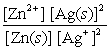
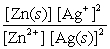
Write the mass-action expression, Qc , for the following chemical reaction. Zn(s) + 2Ag+(aq) Write the mass-action expression, Q<sub>c </sub>, for the following chemical reaction. Zn(s)  + 2Ag<sup>+</sup>(aq)    Zn<sup>2+</sup>(aq)  + 2Ag(s)  A)    B)    C)    D)    E)   Zn2+(aq) + 2Ag(s)


A) Write the mass-action expression, Q<sub>c </sub>, for the following chemical reaction. Zn(s)  + 2Ag<sup>+</sup>(aq)    Zn<sup>2+</sup>(aq)  + 2Ag(s)  A)    B)    C)    D)    E)
B) Write the mass-action expression, Q<sub>c </sub>, for the following chemical reaction. Zn(s)  + 2Ag<sup>+</sup>(aq)    Zn<sup>2+</sup>(aq)  + 2Ag(s)  A)    B)    C)    D)    E)
C) Write the mass-action expression, Q<sub>c </sub>, for the following chemical reaction. Zn(s)  + 2Ag<sup>+</sup>(aq)    Zn<sup>2+</sup>(aq)  + 2Ag(s)  A)    B)    C)    D)    E)
D) Write the mass-action expression, Q<sub>c </sub>, for the following chemical reaction. Zn(s)  + 2Ag<sup>+</sup>(aq)    Zn<sup>2+</sup>(aq)  + 2Ag(s)  A)    B)    C)    D)    E)
E) Write the mass-action expression, Q<sub>c </sub>, for the following chemical reaction. Zn(s)  + 2Ag<sup>+</sup>(aq)    Zn<sup>2+</sup>(aq)  + 2Ag(s)  A)    B)    C)    D)    E)

F) None of the above
G) A) and B)

Correct Answer

verifed

verified

The following reaction is at equilibrium at a pressure of 1 atm, in a closed container. NaOH(s) + CO2(g) The following reaction is at equilibrium at a pressure of 1 atm, in a closed container. NaOH(s)  + CO<sub>2</sub>(g)    NaHCO<sub>3</sub>(s)  <font face= symbol ></font>H°<sub>rxn</sub> < 0 Which, if any, of the following actions will decrease the concentration of CO<sub>2</sub> gas present at equilibrium? A)  adding N<sub>2</sub> gas to double the pressure B)  adding more solid NaOH C)  increasing the volume of the container D)  lowering the temperature E)  none of the above NaHCO3(s) rxn < 0 Which, if any, of the following actions will decrease the concentration of CO2 gas present at equilibrium?


A) adding N2 gas to double the pressure
B) adding more solid NaOH
C) increasing the volume of the container
D) lowering the temperature
E) none of the above

F) B) and E)
G) A) and C)

Correct Answer

verifed

verified

At 450°C, tert-butyl alcohol decomposes into water and isobutene. (CH3) 3COH(g) At 450°C, tert-butyl alcohol decomposes into water and isobutene. (CH<sub>3</sub>) <sub>3</sub>COH(g)    (CH<sub>3</sub>) <sub>2</sub>CCH<sub>2</sub>(g)  + H<sub>2</sub>O(g)  A reaction vessel contains these compounds at equilibrium. What will happen if the volume of the container is reduced by 50% at constant temperature? A)  The forward reaction will proceed to reestablish equilibrium. B)  The reverse reaction will proceed to reestablish equilibrium. C)  No change occurs. D)  The equilibrium constant will increase. E)  The equilibrium constant will decrease. (CH3) 2CCH2(g) + H2O(g) A reaction vessel contains these compounds at equilibrium. What will happen if the volume of the container is reduced by 50% at constant temperature?


A) The forward reaction will proceed to reestablish equilibrium.
B) The reverse reaction will proceed to reestablish equilibrium.
C) No change occurs.
D) The equilibrium constant will increase.
E) The equilibrium constant will decrease.

F) B) and C)
G) A) and E)

Correct Answer

verifed

verified

Nitric oxide and bromine were allowed to react in a sealed container. When equilibrium was reached PNO = 0.526 atm, Nitric oxide and bromine were allowed to react in a sealed container. When equilibrium was reached P<sub>NO</sub> = 0.526 atm,   = 1.59 atm, and P<sub>NOBr</sub> = 7.68 atm. Calculate K<sub>p</sub> for the reaction. 2NO(g)  + Br<sub>2</sub>(g)    2NOBr(g)  A)  7.45 × 10<sup>-3</sup> B)  0.109 C)  9.18 D)  91.8 E)  134 = 1.59 atm, and PNOBr = 7.68 atm. Calculate Kp for the reaction. 2NO(g) + Br2(g) Nitric oxide and bromine were allowed to react in a sealed container. When equilibrium was reached P<sub>NO</sub> = 0.526 atm,   = 1.59 atm, and P<sub>NOBr</sub> = 7.68 atm. Calculate K<sub>p</sub> for the reaction. 2NO(g)  + Br<sub>2</sub>(g)    2NOBr(g)  A)  7.45 × 10<sup>-3</sup> B)  0.109 C)  9.18 D)  91.8 E)  134 2NOBr(g)


A) 7.45 × 10⁻³
B) 0.109
C) 9.18
D) 91.8
E) 134

F) None of the above
G) B) and D)

Correct Answer

verifed

verified

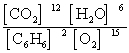
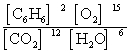
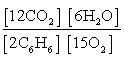
Write the mass-action expression, Qc, for the following chemical reaction equation. 2C6H6(g) + 15O2(g) Write the mass-action expression, Q<sub>c</sub>, for the following chemical reaction equation. 2C<sub>6</sub>H<sub>6</sub>(g)  + 15O<sub>2</sub>(g)    12CO<sub>2</sub>(g)  + 6H<sub>2</sub>O(g)  A)    B)    C)    D)    E)   12CO2(g) + 6H2O(g)


A) Write the mass-action expression, Q<sub>c</sub>, for the following chemical reaction equation. 2C<sub>6</sub>H<sub>6</sub>(g)  + 15O<sub>2</sub>(g)    12CO<sub>2</sub>(g)  + 6H<sub>2</sub>O(g)  A)    B)    C)    D)    E)
B) Write the mass-action expression, Q<sub>c</sub>, for the following chemical reaction equation. 2C<sub>6</sub>H<sub>6</sub>(g)  + 15O<sub>2</sub>(g)    12CO<sub>2</sub>(g)  + 6H<sub>2</sub>O(g)  A)    B)    C)    D)    E)
C) Write the mass-action expression, Q<sub>c</sub>, for the following chemical reaction equation. 2C<sub>6</sub>H<sub>6</sub>(g)  + 15O<sub>2</sub>(g)    12CO<sub>2</sub>(g)  + 6H<sub>2</sub>O(g)  A)    B)    C)    D)    E)
D) Write the mass-action expression, Q<sub>c</sub>, for the following chemical reaction equation. 2C<sub>6</sub>H<sub>6</sub>(g)  + 15O<sub>2</sub>(g)    12CO<sub>2</sub>(g)  + 6H<sub>2</sub>O(g)  A)    B)    C)    D)    E)
E) Write the mass-action expression, Q<sub>c</sub>, for the following chemical reaction equation. 2C<sub>6</sub>H<sub>6</sub>(g)  + 15O<sub>2</sub>(g)    12CO<sub>2</sub>(g)  + 6H<sub>2</sub>O(g)  A)    B)    C)    D)    E)

F) A) and E)
G) A) and B)

Correct Answer

verifed

verified

A good catalyst for a reaction will speed up the forward reaction and slow down the reverse reaction.

A) True
B) False

Correct Answer

verifed

verified

The reaction system CS2(g) + 4H2(g) The reaction system CS<sub>2</sub>(g)  + 4H<sub>2</sub>(g)    CH<sub>4</sub>(g)  + 2H<sub>2</sub>S(g)  Is at equilibrium. Which of the following statements describes the behavior of the system if the partial pressure of hydrogen is doubled? A)  As equilibrium is reestablished, the partial pressure of carbon disulfide increases. B)  As equilibrium is reestablished, the partial pressure of methane, CH<sub>4</sub>, decreases. C)  As equilibrium is reestablished, the partial pressure of hydrogen decreases. D)  As equilibrium is reestablished, the partial pressure of hydrogen sulfide decreases. E)  As equilibrium is reestablished, all the partial pressures will decrease. CH4(g) + 2H2S(g) Is at equilibrium. Which of the following statements describes the behavior of the system if the partial pressure of hydrogen is doubled?


A) As equilibrium is reestablished, the partial pressure of carbon disulfide increases.
B) As equilibrium is reestablished, the partial pressure of methane, CH4, decreases.
C) As equilibrium is reestablished, the partial pressure of hydrogen decreases.
D) As equilibrium is reestablished, the partial pressure of hydrogen sulfide decreases.
E) As equilibrium is reestablished, all the partial pressures will decrease.

F) None of the above
G) C) and D)

Correct Answer

verifed

verified

Sodium hydrogen carbonate decomposes above 110°C to form sodium carbonate, water, and carbon dioxide. 2NaHCO3(s) Sodium hydrogen carbonate decomposes above 110°C to form sodium carbonate, water, and carbon dioxide. 2NaHCO<sub>3</sub>(s)    Na<sub>2</sub>CO<sub>3</sub>(s)  + H<sub>2</sub>O(g)  + CO<sub>2</sub>(g)  One thousand grams of sodium hydrogen carbonate are added to a reaction vessel, the temperature is increased to 200°C, and the system comes to equilibrium. What happens in this system if another 50 g of sodium carbonate are now added? A)  The partial pressure of carbon dioxide will increase. B)  The partial pressure of carbon dioxide will decrease. C)  The partial pressure of carbon dioxide will be unchanged. D)  The amounts of all products will be greater when equilibrium is reestablished. E)  None of the above conclusions is justified without knowing the equilibrium constant. Na2CO3(s) + H2O(g) + CO2(g) One thousand grams of sodium hydrogen carbonate are added to a reaction vessel, the temperature is increased to 200°C, and the system comes to equilibrium. What happens in this system if another 50 g of sodium carbonate are now added?


A) The partial pressure of carbon dioxide will increase.
B) The partial pressure of carbon dioxide will decrease.
C) The partial pressure of carbon dioxide will be unchanged.
D) The amounts of all products will be greater when equilibrium is reestablished.
E) None of the above conclusions is justified without knowing the equilibrium constant.

F) B) and E)
G) B) and D)

Correct Answer

verifed

verified

Carbon monoxide and chlorine combine in an equilibrium reaction to produce the highly toxic product, phosgene (COCl2) CO(g) + Cl2(g) Carbon monoxide and chlorine combine in an equilibrium reaction to produce the highly toxic product, phosgene (COCl<sub>2</sub>)  CO(g)  + Cl<sub>2</sub>(g)    <sub> </sub> COCl<sub>2</sub>(g)  If the equilibrium constant for this reaction is K<sub>c</sub> = 248, predict, if possible, what will happen when the reactants and product are combined with the concentrations shown. [CO] = [Cl<sub>2</sub>] = 0.010 M; [COCl<sub>2</sub>] = 0.070 M A)  The reaction will proceed to the right. B)  The reaction will proceed to the left. C)  The reaction is at equilibrium, and no change in concentrations will occur. D)  The container volume needs to be specified before a prediction can be made. E)  The temperature needs to be specified before a prediction can be made. COCl2(g) If the equilibrium constant for this reaction is Kc = 248, predict, if possible, what will happen when the reactants and product are combined with the concentrations shown. [CO] = [Cl2] = 0.010 M; [COCl2] = 0.070 M


A) The reaction will proceed to the right.
B) The reaction will proceed to the left.
C) The reaction is at equilibrium, and no change in concentrations will occur.
D) The container volume needs to be specified before a prediction can be made.
E) The temperature needs to be specified before a prediction can be made.

F) C) and E)
G) All of the above

Correct Answer

verifed

verified

What is the mass-action expression, Qp, for the following reaction? SbF5(g) + 4Cl2(g) What is the mass-action expression, Q<sub>p</sub>, for the following reaction? SbF<sub>5</sub>(g)  + 4Cl<sub>2</sub>(g)    SbCl<sub>3</sub>(g)  + 5ClF(g)  A)    B)    C)    D)    E)  None of the above is the correct mass-action expression. SbCl3(g) + 5ClF(g)


A) What is the mass-action expression, Q<sub>p</sub>, for the following reaction? SbF<sub>5</sub>(g)  + 4Cl<sub>2</sub>(g)    SbCl<sub>3</sub>(g)  + 5ClF(g)  A)    B)    C)    D)    E)  None of the above is the correct mass-action expression.
B) What is the mass-action expression, Q<sub>p</sub>, for the following reaction? SbF<sub>5</sub>(g)  + 4Cl<sub>2</sub>(g)    SbCl<sub>3</sub>(g)  + 5ClF(g)  A)    B)    C)    D)    E)  None of the above is the correct mass-action expression.
C) What is the mass-action expression, Q<sub>p</sub>, for the following reaction? SbF<sub>5</sub>(g)  + 4Cl<sub>2</sub>(g)    SbCl<sub>3</sub>(g)  + 5ClF(g)  A)    B)    C)    D)    E)  None of the above is the correct mass-action expression.
D) What is the mass-action expression, Q<sub>p</sub>, for the following reaction? SbF<sub>5</sub>(g)  + 4Cl<sub>2</sub>(g)    SbCl<sub>3</sub>(g)  + 5ClF(g)  A)    B)    C)    D)    E)  None of the above is the correct mass-action expression.
E) None of the above is the correct mass-action expression.

F) A) and B)
G) A) and D)

Correct Answer

verifed

verified

Stearic acid, nature's most common fatty acid, dimerizes when dissolved in hexane: 2C17H35COOH Stearic acid, nature's most common fatty acid, dimerizes when dissolved in hexane: 2C<sub>17</sub>H<sub>35</sub>COOH   (C<sub>17</sub>H<sub>35</sub>COOH) <sub>2 </sub><font face= symbol ></font>H°<sub>rxn</sub> = -172 kJ The equilibrium constant for this reaction at 28°C is 2900. Estimate the equilibrium constant at 38°C. A)  4.7 × 10<sup>5</sup> B)  2.6 × 10<sup>4</sup> C)  1.9 × 10<sup>3</sup> D)  3.2 × 10<sup>2</sup> E)  18 (C17H35COOH) 2 rxn = -172 kJ The equilibrium constant for this reaction at 28°C is 2900. Estimate the equilibrium constant at 38°C.


A) 4.7 × 10⁵
B) 2.6 × 10⁴
C) 1.9 × 10³
D) 3.2 × 10²
E) 18

F) A) and B)
G) A) and C)

Correct Answer

verifed

verified

At high temperatures, carbon reacts with O2 to produce CO as follows: C(s) + O2(g) At high temperatures, carbon reacts with O<sub>2</sub> to produce CO as follows: C(s)  + O<sub>2</sub>(g)    <sub> </sub> 2CO(g) . When 0.350 mol of O<sub>2</sub> and excess carbon were placed in a 5.00-L container and heated, the equilibrium concentration of CO was found to be 0.060 M. What is the equilibrium constant, K<sub>c</sub>, for this reaction? A)  0.010 B)  0.072 C)  0.090 D)  0.17 E)  1.2 2CO(g) . When 0.350 mol of O2 and excess carbon were placed in a 5.00-L container and heated, the equilibrium concentration of CO was found to be 0.060 M. What is the equilibrium constant, Kc, for this reaction?


A) 0.010
B) 0.072
C) 0.090
D) 0.17
E) 1.2

F) A) and D)
G) None of the above

Correct Answer

verifed

verified

The equilibrium constant for reaction (1) below is 276. Under the same conditions, what is the equilibrium constant of reaction (2) ? (1) The equilibrium constant for reaction (1)  below is 276. Under the same conditions, what is the equilibrium constant of reaction (2) ? (1)    X<sub>2</sub>(g)  +   Y<sub>2</sub>(g)    XY(g)  (2)  2XY(g)    X<sub>2</sub>(g)  + Y<sub>2</sub>(g)  A)  6.02 × 10<sup>-2</sup> B)  7.25 × 10<sup>-3</sup> C)  3.62 × 10<sup>-3</sup> D)  1.31 × 10<sup>-5</sup> E)  none of the above X2(g) + The equilibrium constant for reaction (1)  below is 276. Under the same conditions, what is the equilibrium constant of reaction (2) ? (1)    X<sub>2</sub>(g)  +   Y<sub>2</sub>(g)    XY(g)  (2)  2XY(g)    X<sub>2</sub>(g)  + Y<sub>2</sub>(g)  A)  6.02 × 10<sup>-2</sup> B)  7.25 × 10<sup>-3</sup> C)  3.62 × 10<sup>-3</sup> D)  1.31 × 10<sup>-5</sup> E)  none of the above Y2(g) The equilibrium constant for reaction (1)  below is 276. Under the same conditions, what is the equilibrium constant of reaction (2) ? (1)    X<sub>2</sub>(g)  +   Y<sub>2</sub>(g)    XY(g)  (2)  2XY(g)    X<sub>2</sub>(g)  + Y<sub>2</sub>(g)  A)  6.02 × 10<sup>-2</sup> B)  7.25 × 10<sup>-3</sup> C)  3.62 × 10<sup>-3</sup> D)  1.31 × 10<sup>-5</sup> E)  none of the above XY(g) (2) 2XY(g) The equilibrium constant for reaction (1)  below is 276. Under the same conditions, what is the equilibrium constant of reaction (2) ? (1)    X<sub>2</sub>(g)  +   Y<sub>2</sub>(g)    XY(g)  (2)  2XY(g)    X<sub>2</sub>(g)  + Y<sub>2</sub>(g)  A)  6.02 × 10<sup>-2</sup> B)  7.25 × 10<sup>-3</sup> C)  3.62 × 10<sup>-3</sup> D)  1.31 × 10<sup>-5</sup> E)  none of the above X2(g) + Y2(g)


A) 6.02 × 10⁻²
B) 7.25 × 10⁻³
C) 3.62 × 10⁻³
D) 1.31 × 10⁻⁵
E) none of the above

F) A) and B)
G) D) and E)

Correct Answer

verifed

verified

The following reaction, in CCl4 solvent, has been studied at 25°C. 2BrCl The following reaction, in CCl<sub>4</sub> solvent, has been studied at 25°C. 2BrCl   Br<sub>2 </sub> + Cl<sub>2</sub> The equilibrium constant K<sub>c</sub> is known to be 0.141. If the initial concentration of chlorine is 0.0300 M and of bromine monochloride is 0.0200 M, what is the equilibrium concentration of bromine? A)  1.35 × 10<sup>-3 </sup>M B)  2.70 × 10<sup>-3</sup> M C)  8.82 × 10<sup>-3</sup> M D)  9.70 × 10<sup>-2 </sup>M E)  none of the above Br2 + Cl2 The equilibrium constant Kc is known to be 0.141. If the initial concentration of chlorine is 0.0300 M and of bromine monochloride is 0.0200 M, what is the equilibrium concentration of bromine?


A) 1.35 × 10⁻³ M
B) 2.70 × 10⁻³ M
C) 8.82 × 10⁻³ M
D) 9.70 × 10⁻² M
E) none of the above

F) C) and D)
G) B) and E)

Correct Answer

verifed

verified

SO2 reacts with O2 to produce SO3. If 86.0 g of SO2 is placed in a reaction vessel along with excess oxygen gas, how many moles of SO2 remain when 50.0 g of SO3 have been formed?


A) 0.56 mol
B) 0.62 mol
C) 0.72 mol
D) 0.78 mol
E) 1.34 mol

F) None of the above
G) A) and E)

Correct Answer

verifed

verified

In a chemical reaction, if the starting concentrations of reactants are increased, then the equilibrium constant Kc will also increase.

A) True
B) False

Correct Answer

verifed

verified

Showing 41 - 60 of 104

Related Exams

Show Answer