A) the U.S. inflation rate as measured by the GDP deflator was higher than that measured by the CPI, and the difference was explained by rapidly rising prices of goods exported by the U.S.
B) the U.S. inflation rate as measured by the CPI was higher than that measured by the GDP deflator, and the difference was explained by rapidly rising prices of goods exported by the U.S.
C) the U.S. inflation rate as measured by the GDP deflator was higher than that measured by the CPI, and the difference was explained by rapidly rising oil prices.
D) the U.S. inflation rate as measured by the CPI was higher than that measured by the GDP deflator, and the difference was explained by rapidly rising oil prices.
F) None of the above
Correct Answer

verified
Correct Answer
verified
B) False
Correct Answer
verified
Correct Answer
verified
Correct Answer
verified
Correct Answer
verified
A) 4.6 percent.
B) 6.5 percent.
C) 4.4 percent.
D) 46.5 percent.
F) A) and C)
Correct Answer
verified
Correct Answer
verified
A) CPI in year 1 = 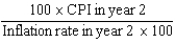
B) CPI in year 1 = 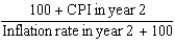
C) CPI in year 1 = 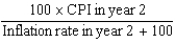
D) CPI in year 1 = 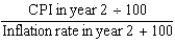
F) None of the above
Correct Answer
verified
Correct Answer
verified
A) fails to account for consumer spending on housing.
B) accounts only for consumer spending on food, clothing, and energy.
C) fails to account for the fact that consumers spend larger percentages of their incomes on some goods and smaller percentages of their incomes on other goods.
D) fails to account for the introduction of new goods.
F) A) and C)
Correct Answer
verified
Correct Answer
verified
B) False
Correct Answer
verified
Correct Answer
verified
A) $17 more in his account, and his purchasing power has increased by $10.
B) $30 more in his account, and his purchasing power has increased by $50.
C) $40 more in his account, and his purchasing power has increased by $33.
D) $50 more in his account, and his purchasing power has increased by $33.
F) A) and D)
Correct Answer
verified
Correct Answer
verified
A) 41 percent.
B) 15 percent.
C) 6 percent.
D) 4 percent.
F) A) and B)
Correct Answer
verified
Correct Answer
verified
A) in the consumer price index and in the GDP deflator.
B) in the consumer price index, but not in the GDP deflator.
C) in the GDP deflator, but not in the consumer price index.
D) in neither the consumer price index nor in the GDP deflator.
F) B) and D)
Correct Answer
verified
Correct Answer
verified
B) False
Correct Answer
verified
Correct Answer
verified
A) the CPI is a price index, while the GDP deflator is an inflation index.
B) substitution bias is not a problem with the CPI, but it is a problem with the GDP deflator.
C) increases in the prices of foreign produced goods that are sold to U.S. consumers show up in the CPI but not in the GDP deflator.
D) increases in the prices of domestically produced goods that are sold to the U.S. government show up in the CPI but not in the GDP deflator.
F) B) and D)
Correct Answer
verified
Correct Answer
verified
A) 100 in 2012, 123.8 in 2013, and 133.3 in 2014.
B) 100 in 2012, 124.2 in 2013, and 133.3 in 2014.
C) 210 in 2012, 260 in 2013, and 280 in 2014.
D) 100 in 2012, 150 in 2013, and 170 in 2014.
F) A) and D)
Correct Answer
verified
Correct Answer
verified
A) $45,953.
B) $89,280.
C) $107,953.
D) $83,651.
F) B) and D)
Correct Answer
verified
Correct Answer
verified
A) 100 to 110
B) 150 to 165
C) 180 to 198
D) All of these changes produce the same rate of inflation.
F) All of the above
Correct Answer
verified
Correct Answer
verified
B) False
Correct Answer
verified
Correct Answer
verified
A) If the inflation rate exceeds the nominal interest rate, then the purchasing power of an interest-earning deposit falls over time.
B) If there is deflation, then the purchasing power of an interest-earning deposit rises by more than the nominal interest rate over time.
C) The higher the rate of inflation, the smaller the increase in the purchasing power of an interest-earning deposit.
D) The purchasing power of an interest-earning deposit can increase or decrease over time, but it cannot stay the same.
F) A) and B)
Correct Answer
verified
Correct Answer
verified
B) False
Correct Answer
verified
Correct Answer
verified
A) 0.
B) 1.
C) 80.
D) 100.
F) B) and C)
Correct Answer
verified
Correct Answer
verified
A) 6 percent.
B) 19 percent.
C) 14 percent.
D) 17 percent.
F) None of the above
Correct Answer
verified
Correct Answer
verified
Showing 341 - 360 of 543
Related Exams